
Every casino bonus you will ever come across carries a wagering requirement. No exceptions. Whether it is a no deposit bonus, a welcome match, free spins, or a reload offer, the same condition applies every time. You must bet a set amount before any of your bonus winnings can leave the casino as real cash.
Most players learn this after claiming a bonus. This guide is for learning it before.
What follows is a straightforward breakdown of how wagering requirements are calculated, what the terms inside them actually mean, and how to read any offer in under a minute so you know exactly what you are agreeing to before you opt in.
Breaking Down the Multiplier
Every wagering requirement is expressed as a multiplier. You will see it written as 20x, 30x, 40x, or higher. That number tells you how many times the applicable amount must be bet in total before your winnings unlock for withdrawal.
The calculation itself is simple. Multiply the applicable amount by the multiplier and you have your total betting obligation.
A $50 bonus with a 30x requirement means $1,500 in total bets. A $20 bonus with a 40x requirement means $800. The math takes ten seconds. The part that catches most players off guard is what “applicable amount” actually means, because it is not always just the bonus.
Bonus Only vs Bonus Plus Deposit
This is the distinction that makes the biggest practical difference, and it is the one most guides skim over.
Some casinos apply the wagering multiplier only to the bonus amount. If you receive a $100 bonus with a 25x requirement, your total obligation is $2,500. Your deposit is not included.
Other casinos apply the multiplier to both your bonus and your deposit combined. If you deposit $100 and receive a $100 bonus, your starting base is $200. At 25x, your total obligation jumps to $5,000. Same multiplier. Same bonus amount. Twice the work.
Both offers can appear identical in the headline. The difference sits in one line of the terms, usually written as “wagering applies to bonus only” or “wagering applies to deposit and bonus.” Finding that line before you claim is the single most important thing you can do when evaluating any bonus offer.

A 20x requirement on bonus plus deposit can demand more play from you than a 35x requirement on bonus only. The multiplier alone tells you nothing without knowing what it applies to.
What a Realistic Range Looks Like
Wagering requirements vary widely across different bonus types and different casinos. Knowing the general landscape helps you spot immediately whether any specific offer is reasonable or not.
For no deposit bonuses, requirements typically sit between 30x and 60x applied to bonus only. The higher end reflects the fact that the casino received nothing from you before handing over the funds.
For deposit match bonuses, requirements generally range from 20x to 40x. These tend to be more achievable because the casino already has your deposit in the account.
Anything above 60x on any bonus type is a signal worth pausing on. At that level, the statistical likelihood of clearing the requirement from a small starting balance drops sharply, and the offer is structured more to generate platform activity than to produce successful withdrawals.
For a full breakdown of how wagering requirements apply specifically to no deposit bonuses and free spins, our guide on no deposit casino bonuses covers both in detail.
Game Contribution Rates and Why They Matter More Than the Multiplier
Most players read the wagering multiplier and stop there. That number alone does not tell you how much play the bonus actually requires. The game you choose to clear it with does.
Game contribution rates are the percentages that determine how much of each bet counts toward your wagering obligation. A $10 bet does not always add $10 to your progress. In most cases it does, but only if you are playing the right kind of game.
How Contribution Rates Work in Practice
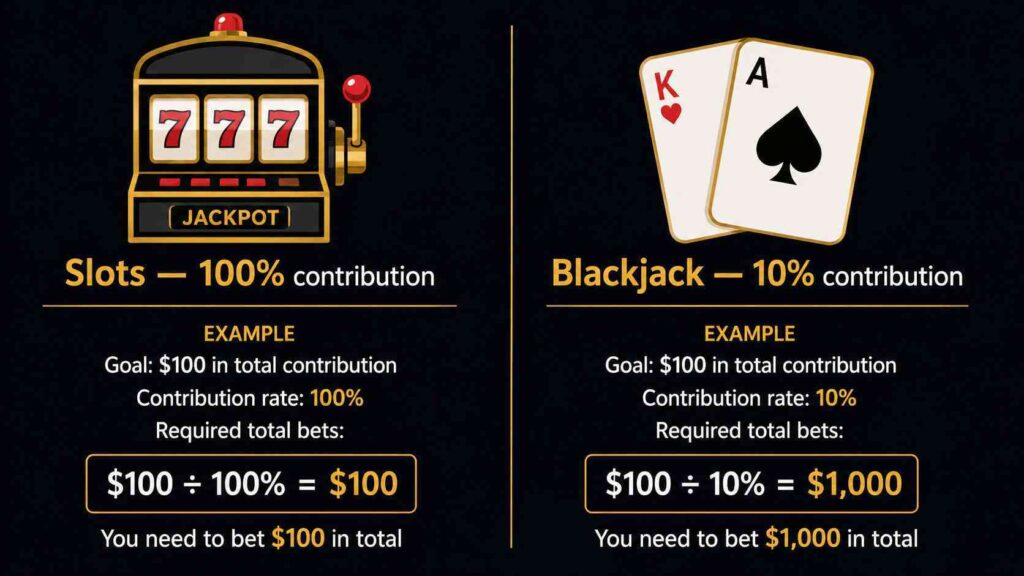
Slot games carry a 100% contribution rate at almost every casino. Every dollar you bet on slots counts as a full dollar toward your wagering requirement. A $600 obligation cleared entirely on slots requires exactly $600 in bets.
Table games work very differently. Blackjack, roulette, baccarat, and similar games typically contribute between 5% and 20% of each bet toward the requirement. Some casinos exclude them entirely. Live dealer versions of these games usually fall into the same low-contribution category.
The practical impact of this gap is far larger than most players realise. Take a $30x requirement on a $20 bonus. Your total obligation is $600. Playing exclusively on slots at 100% contribution means $600 in bets clears it. Playing blackjack at a 10% contribution rate means only $60 of every $600 wagered counts. To clear the same $600 obligation on blackjack at that rate, you need to place $6,000 in total bets. Ten times the work for the same result.
Why Casinos Set Contribution Rates This Way
The reason sits in the house edge of each game type.
Slot games typically return between 94% and 97% of all money wagered over time. That 3% to 6% gap is the casino’s margin, and it is wide enough that allowing full contribution on slots still leaves the casino profitable after absorbing the bonus cost.
Blackjack played with basic strategy can return over 99%. The casino’s margin on that game is less than 1%. If blackjack counted fully toward wagering requirements, a player could methodically clear a large bonus at almost zero net cost to themselves. Contribution rates prevent that scenario.
This is not a rule designed to trap you. It is a balancing mechanism. But knowing it changes how you plan your sessions. A bonus that looks generous based on the multiplier alone can become far more demanding once you factor in the contribution rate of the game you actually want to play.
Before you claim any bonus, find the game contribution table in the terms. It is usually listed under “eligible games” or “wagering contributions.” If the games you prefer carry a low contribution rate, the effective wagering requirement on that bonus is much higher than the headline number suggests.
For a practical look at how contribution rates affect free spins specifically, our free spins no deposit guide covers the same concept in the context of spin-based offers.
The Terms Most Players Never Read
The multiplier gets all the attention. Game contribution rates get some. These four terms get almost none, which is exactly why they cause more problems than either of the two everyone already knows about.
Miss any one of them and a bonus you cleared perfectly can still end in a declined withdrawal.
The Maximum Bet Limit
Almost every bonus carries a maximum bet limit that applies for the entire duration of the wagering requirement. This cap is typically set between $3 and $5 per spin or per hand. Placing a single bet above that limit while a bonus is active is enough for many casinos to void the entire bonus and any winnings attached to it.
The problem is not the rule. It is how quietly it sits in the terms. Most players never find it until after a withdrawal is declined and they trace back through the conditions to figure out why.
Before you place your first bet on any bonus, find the maximum bet limit. Set your stake at or below it and do not change it upward during the session regardless of how the balance looks. One bet over the cap can erase everything that came before it.
The Expiry Window as a Daily Target
Every bonus expires. The window ranges from 24 hours on some no deposit offers to 30 days on larger deposit matches. When that window closes, the bonus and any associated winnings disappear regardless of how far you progressed through the requirement.
Most players treat the expiry date as a distant deadline. A more useful way to read it is as a daily betting target.
Take your total wagering obligation and divide it by the number of days in the window. That number tells you how much you need to bet per day to clear the requirement on time. A $600 obligation over 7 days means roughly $86 per day. Over 3 days it means $200. If that daily figure does not fit your realistic playing schedule, the offer is not worth starting.
Prohibited Play
This clause appears in the general terms of most casinos rather than in the specific bonus terms, which is why most players never see it. It covers betting patterns the casino classifies as bonus abuse, and it gives the casino the right to void your bonus if it determines you have used any of them.
Common examples include placing simultaneous bets on opposite outcomes of the same game to reduce risk, using progressive betting systems that exploit low-variance play, or deliberately switching between games to take advantage of contribution rate differences in ways the casino deems manipulative.
You do not need to be attempting anything intentional for this clause to be applied. Playing conservatively to protect your balance during a wagering session can sometimes be flagged under these rules at certain casinos. Understanding that this clause exists and knowing the general terms of any casino before you claim a bonus removes most of the risk.
The Opt Out Option
This is the term almost no guide covers, and it is genuinely useful to know about.
Most casinos allow you to opt out of an active bonus before it is cleared. This removes the bonus balance and any associated wagering requirement from your account, leaving your real money balance untouched. If you claimed a bonus and then decided the wagering requirement was more than you wanted to commit to, opting out is the clean way to move on without the requirement hanging over the account.
The opt out option is usually found in the promotions or bonus section of your account. Some casinos process it instantly. Others require a support request. Either way, knowing it exists means you are never locked into a bonus you no longer want to pursue.
For a complete breakdown of how to find and read every bonus term before you commit, our guide to reading bonus terms covers the full process.
How to Evaluate Any Wagering Requirement Before You Claim
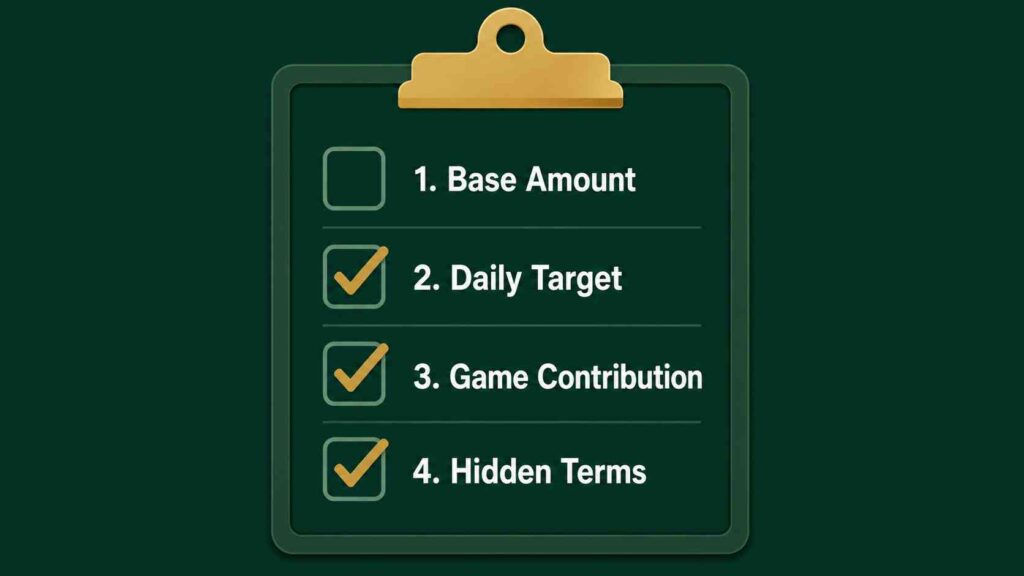
Reading a bonus offer takes three minutes if you know what you are looking for. Most players spend those three minutes on the headline number and miss everything underneath it. This section gives you a practical sequence for evaluating any offer before you commit to it.
Start With the Base Amount
Before anything else, find out what the wagering multiplier actually applies to. Bonus only or bonus plus deposit. This single line changes the entire calculation.
If the terms say bonus only, multiply the bonus amount by the multiplier. If they say bonus plus deposit, add both figures together first, then multiply. Write that number down. It is your total betting obligation, and every other evaluation step builds on it.
Turn the Obligation Into a Daily Number
Take that total and divide it by the number of days in the expiry window. That is your daily betting target.
Compare it honestly against the time you can realistically spend playing each day. If the daily target requires two hours of continuous slots play and you have 30 minutes, the offer does not fit your schedule regardless of how attractive the bonus looks. This calculation takes 20 seconds and eliminates a large number of offers immediately.
Check the Games Before You Check Anything Else
Find the game contribution table in the terms. If the games you actually enjoy carry a low contribution rate, recalculate your effective obligation using the contribution percentage.
Divide your total betting obligation by the contribution rate of your preferred game. A $600 obligation at 10% contribution on blackjack becomes $6,000 in required bets. If that number makes the offer unrealistic, it is unrealistic regardless of what the headline multiplier says.
Also check whether your deposit method is eligible for the bonus. Some casinos exclude specific payment methods, including certain e-wallets and cryptocurrency options, from bonus qualifying. Depositing through an excluded method means the bonus never activates even if everything else is in order.
The Three Questions Worth Asking at the End
Once the numbers check out, three final questions determine whether the offer is actually worth claiming.
Is the maximum cashout limit meaningful relative to the bonus? A $20 bonus with a $25 max cashout barely justifies the time required to clear it.
Is the maximum bet limit clearly stated? If you cannot find it in the terms, contact support before you start playing.
Do you actually want to play the eligible games? Clearing a wagering requirement on games you have no interest in is a poor use of time even when the math is technically achievable.
If any of these three questions produces a bad answer, walk away from the offer. Another one will come along with better terms. The casino that makes you work hardest to find the information is rarely the one with the fairest conditions.
Frequently Asked Questions
What is the difference between a wagering requirement and a playthrough requirement?
Nothing. Both terms describe the same condition. Wagering requirement is the more commonly used phrase across most international casinos. Playthrough and rollover are used interchangeably at different platforms, with rollover appearing more frequently at casinos catering to North American players. Regardless of which term a casino uses, the calculation and the rules attached to it work exactly the same way. When you encounter any of these three terms on a bonus offer, treat them as identical.
Does the wagering requirement apply to my real money balance or only to the bonus?
Only to the bonus funds and any winnings generated from them. Your real money deposit sits in a separate balance and is not subject to the wagering requirement. However, some casinos specify that your real money balance must be played through before the bonus balance activates. In those cases, your own funds are used first on every bet, and only once the real money balance reaches zero do your bonus funds come into play. Check the terms for any language around balance priority before you start playing.
Can I withdraw my real money deposit while a bonus is still active?
At most casinos, attempting to withdraw while a bonus is active will result in the bonus and all associated winnings being cancelled before the withdrawal is processed. Your real money funds will be returned, but the bonus disappears entirely. Some casinos allow you to opt out of the bonus first and then withdraw your real money without any penalty. If you deposited and claimed a bonus but now only want to withdraw your deposit, contact support before doing anything to understand exactly how that casino handles it.
What is a sticky bonus and how does it affect the wagering requirement?
A sticky bonus is a bonus that contributes to your playing balance during wagering but cannot itself be withdrawn when the requirement is cleared. Only the winnings above the original bonus amount become withdrawable cash. So if you receive a $30 sticky bonus and clear the wagering requirement with a balance of $90, you withdraw $60 in winnings and the original $30 stays with the casino. Sticky bonuses are not always labeled as such in the terms. If the bonus terms say the bonus amount is non-withdrawable or will be deducted upon withdrawal, that is a sticky bonus.
What happens if I run out of bonus funds before clearing the wagering requirement?
The bonus is gone. If your bonus balance reaches zero before the wagering requirement is met, the requirement cannot be completed and no winnings are available to withdraw. The expiry window becomes irrelevant at that point because there is nothing left to wager. Some casinos allow you to make a new deposit and claim a separate bonus, but this does not revive the previous one. Starting a new bonus does not carry over any progress from the previous requirement.
Do wagering requirements reset if I make another deposit while a bonus is active?
No, the existing wagering requirement does not reset. Your new deposit adds to your real money balance separately. However, if you claim an additional bonus on that deposit, most casinos will stack the requirements, meaning you need to clear both before any withdrawal is possible. Some platforms require you to clear one bonus entirely before a second one can be activated. Check the casino’s general bonus terms for its specific policy on multiple active bonuses before depositing again mid-wagering.
Is a lower wagering requirement always better?
Usually, but not always. A lower multiplier means less total betting required, which is generally more player-friendly. However, the multiplier is only one part of the calculation. A 20x requirement on bonus plus deposit can demand more total play than a 35x requirement on bonus only. A low multiplier attached to a game with 10% contribution also produces a far higher effective requirement than the headline number suggests. Evaluate the full picture rather than using the multiplier alone as the deciding factor.
Can I use a bonus across multiple sessions or do I need to clear it in one sitting?
You can spread your wagering sessions across multiple logins as long as you stay within the expiry window. The requirement tracks your cumulative betting progress, not continuous play time. Each time you log in and place eligible bets, your progress updates. The only clock running between sessions is the expiry countdown. As long as you return and complete the requirement before the window closes, the number of separate sessions does not affect the outcome.
Final Takeaway
Wagering requirements are not the enemy of casino bonuses. They are the mechanism that makes casino bonuses possible in the first place. Without them, no casino could afford to offer free credit, deposit matches, or free spins at scale. Understanding this does not mean accepting every term you encounter without question. It means you can now read any offer clearly and decide whether it is worth your time before you commit to anything.
The multiplier is where most players start and stop. You now know it is only one part of a much larger calculation. What the multiplier applies to, which games clear it fastest, what the hidden terms say about maximum bets, and whether the expiry window fits your schedule all determine the real value of any bonus far more accurately than the headline number alone.
The Simplest Way to Use Everything in This Guide
Before claiming any bonus, calculate the total obligation. Divide it by the expiry window. Check the game contribution rate of what you actually want to play. Find the maximum bet limit. Read the general terms for prohibited play clauses. If all of those checks produce reasonable numbers and clear answers, the bonus is worth considering. If any one of them does not, the opt out option exists for a reason.
A smaller bonus with transparent terms and a manageable requirement is always a better deal than a large bonus built around conditions designed to prevent most players from ever withdrawing anything. The number in the headline is marketing. The terms underneath it are the actual offer.
For more guides on casino bonuses and online gambling, visit Casivono.

Bryan Carter has been writing about online casinos and crypto gambling long enough to know that most of what gets published in this space is dressed up advertising. He started Casivono to fix that. The guides here cover how casino platforms actually work, what the regulation really says, and what players need to know before they put money anywhere. No rankings built around affiliate fees. No five star reviews for platforms that do not deserve them. Just straight information.