
A decade ago the difference between a slot machine and a console game was obvious. One was a grid of spinning fruit symbols on a casino floor. The other was a forty hour narrative experience with a budget that rivaled a Hollywood film. You would not confuse the two.
That comparison no longer holds.
Modern online slots are built on the same engines as PlayStation 5 titles. They are designed by people who spent years working in AAA game studios. Some have original soundtracks composed by the same musicians behind major game releases. A handful feature branching bonus rounds with genuine player input, character arcs that develop across multiple sessions and visual fidelity that would have been impossible to render on consumer hardware five years ago.
This did not happen by accident and it did not happen slowly. The slot industry looked at what console gaming had built, decided its own players expected the same standard, and went and hired the people who knew how to deliver it.
The Engine Running Your Favourite Slot Is the Same One Behind AAA Games
For most of the slot industry’s history the technology gap between casino games and console titles was enormous. Slots ran on proprietary hardware with limited processing power, basic 2D art and audio that looped every thirty seconds. The design constraints were so severe that creativity was essentially impossible at the production level.
That changed when HTML5 made browser-based delivery viable and when Unity and Unreal Engine became accessible to studios outside the traditional games industry. Both engines were already the backbone of the console and PC gaming world. Unity powers roughly half of all mobile games. Unreal Engine 5 is behind some of the most visually demanding titles ever released.
Slot developers adopted both. Not as a compromise or a workaround but as a deliberate upgrade to production infrastructure that had not meaningfully changed in decades. The result is a generation of slots that render in real time using the same Nanite geometry and Lumen lighting systems that power open world console titles. A modern slot running on Unreal Engine 5 is not approximating console quality visuals. It is using identical technology to produce them. For a broader look at how the casino industry rebuilt itself around gaming infrastructure, our guide on EuroGamersOnline from consoles to casinos covers the full picture.
When Slot Studios Started Hiring From Game Studios
Technology alone does not explain the shift. The more significant change was human. Slot developers began recruiting from console and mobile game studios, bringing in people who understood not just how to build games but how to make them feel like something worth returning to.
Art directors from RPG studios. Sound designers who had scored major franchise titles. UX designers who had spent years optimising onboarding flows for live service games. Narrative designers who knew how to build worlds that players wanted to spend time inside. These were not roles that existed in the slot industry before. They exist now because the audience expectations that console gaming created do not switch off when a player opens a casino platform.
What Game Designers Brought That Slot Developers Did Not Have
The most valuable thing game designers imported was an understanding of player experience over time. Traditional slot development optimised for the spin. Game design optimises for the session, the return visit, the emotional arc of extended play.
That difference shows up in everything. Title screens that feel like loading into a game rather than opening a menu. Bonus rounds with genuine build up and release rather than a flat multiplier appearing on screen. Sound design that responds dynamically to player actions rather than looping a generic track underneath every outcome. Tutorial flows that teach mechanics without overwhelming a first time player. None of these are gambling innovations. They are game design fundamentals that the slot industry absorbed by hiring the people who had spent careers applying them.
Storytelling, Character Arcs and the Slot That Thinks It Is an RPG
The visual upgrade was visible immediately. The narrative ambition took longer to become apparent.
Modern flagship slots now ship with protagonists. Not just a thematic backdrop with matching symbols but actual characters with design consistency, voiced dialogue in some cases and story progression that unfolds across bonus rounds. Neon Noir from Microgaming features a cyberpunk environment with dynamic rain effects, a soundtrack composed by a Grammy nominated musician and reel symbols that are three dimensional models reacting to player actions rather than static images. Chronicles of Avalon structures its bonus content as chapters in a knight’s quest, with each set of spins advancing the narrative. These are not gimmicks layered on top of a standard slot. They are the product.
The player who boots up one of these titles and a player loading a narrative action game on console are having experiences that are technically and aesthetically closer to each other than either would be to their respective formats from ten years ago. The slot knows this. That is why it was built this way.

Skill Based Bonus Rounds and the Illusion of Control
The most recent development in console influenced slot design is the skill based bonus round. Rather than a free spin sequence where outcomes are entirely predetermined, some titles now feature interactive segments where the player’s actions genuinely influence the result.
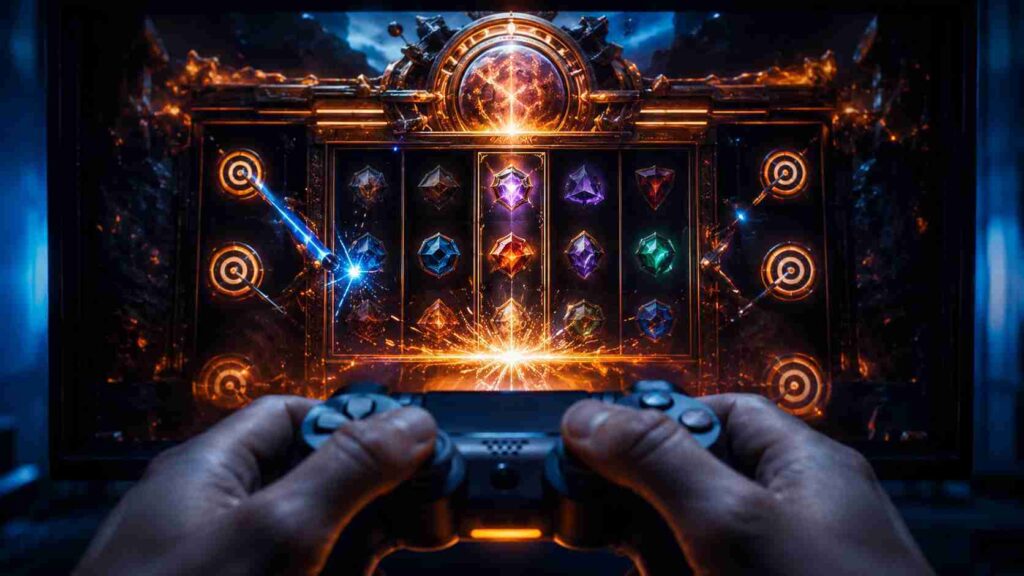
Battle Spin by Evolution Gaming overlays a shoot em up mechanic onto the base game. Players fire at targets during the bonus round and each successful hit boosts the multiplier applied to the spin outcome. Treasure Trail by NetEnt features a puzzle interlude where rearranging symbols unlocks hidden bonus reels. The input is real. The player is doing something, making decisions, reacting to what appears on screen.
What matters for anyone crossing over from gaming is understanding exactly how real that skill component is. The base game remains pure chance governed by an RNG. The skill based segment influences a modifier applied to a predetermined spin result, not the result itself. Your performance in the bonus round changes how much you win from a winning spin. It does not change whether the spin wins. That distinction is explained in detail in our guide on skill vs chance in casino games.
The experience feels like gaming because it borrows gaming’s input language. The underlying mathematics have not changed.
What Has Not Changed Underneath All of It
Every visual upgrade, every narrative layer, every skill based mechanic sits on top of an RNG that has not fundamentally changed since the first digital slot was built. The outcome of every spin is determined by a random number generator before the animation begins. The cinematic reveal, the character reaction, the dynamic lighting that responds to a win, all of it is presentation applied after the result has already been decided.
The house edge is still there. It is still permanent. It still cannot be moved by pattern recognition, session length or understanding of the game’s visual systems. A player who has watched every cutscene, unlocked every narrative chapter and completed every skill based bonus round is not in a statistically different position from a player who loaded the game thirty seconds ago.
This is not a criticism of the design. The production quality in modern slots is genuinely impressive and the experience of playing them has improved enormously. It is context. The gap between a modern slot and a console game has narrowed dramatically in almost every visible dimension. The one dimension where it has not narrowed at all is the one that determines what happens to your money.
Conclusion
The slot industry did not stumble into looking like the games industry. It made a deliberate decision to hire its people, adopt its technology and meet the expectations its audience had already developed through years of console and mobile gaming.
What that produces is a category of casino game that is more visually impressive, more narratively coherent and more experientially engaging than anything that existed ten years ago. For a gamer stepping into this space the aesthetic familiarity is real and the production quality is genuine.
The mathematics underneath are unchanged. Variable ratio reinforcement still drives the engagement loop, as we cover in detail in our guide on variable ratio reinforcement in gaming and gambling. The house edge is still permanent. The RNG still decides every outcome before the animation tells you what it was.
Know what you are looking at. The production budget went up. The odds did not.
For more on navigating the casino world with your eyes open, Casivono covers it all in plain language.
FAQ
Q1: Do modern video slots use the same technology as console games?
Yes. Leading slot developers now build titles using Unreal Engine 5 and Unity, the same engines behind major console and PC releases. Unreal Engine 5’s Nanite geometry and Lumen lighting systems, which power high end console titles, are actively used in slot development in 2026. The rendering technology is identical. The game design principles borrowed from console development are equally direct.
Q2: Why do online slots now look like video games?
Because the slot industry deliberately recruited from game studios and adopted game development infrastructure. Art directors, sound designers, narrative designers and UX specialists from console and mobile backgrounds joined slot development teams from around 2015 onward. The visual and experiential upgrade followed from bringing in people who understood how to build products that players wanted to return to, not just spin once.
Q3: Are skill based slot bonus rounds actually skill based?
Partially. The player’s input in skill based bonus rounds is real and does influence the outcome of the bonus segment. However, the base game result is still determined by an RNG before the bonus triggers. Skill based mechanics typically modify a multiplier applied to a predetermined spin result rather than changing whether that spin wins or loses. The experience feels interactive because it uses gaming’s input language. The underlying mathematics remain chance based.
Q4: Which slot developers use Unreal Engine 5?
Several leading studios have adopted Unreal Engine 5 for slot development including titles from Microgaming, NetEnt and Evolution Gaming’s development arms. The adoption accelerated from 2023 onward as UE5 became production stable and the visual gap between console gaming and slot presentation became a competitive issue for operators trying to retain players who had grown up on high fidelity gaming experiences.
Q5: Does better graphics in a slot mean better odds?
No. Production quality and mathematical odds are entirely separate. A slot with cinematic visuals, a full narrative arc and a licensed soundtrack operates on the same RNG principles and carries the same house edge structure as a basic three reel slot. The RTP and volatility of a game are set independently of its visual design. Better graphics mean a better experience. They do not mean better odds.

Bryan Carter has been writing about online casinos and crypto gambling long enough to know that most of what gets published in this space is dressed up advertising. He started Casivono to fix that. The guides here cover how casino platforms actually work, what the regulation really says, and what players need to know before they put money anywhere. No rankings built around affiliate fees. No five star reviews for platforms that do not deserve them. Just straight information.